
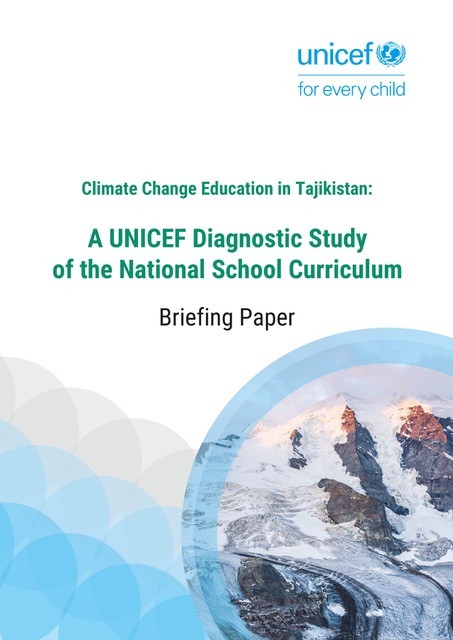
A UNICEF Diagnostic Study of the National School Curriculum: Briefing Paper
Based on the preliminary data collection and analysis conducted by Vladimir Koshcheev, UNICEF Tajikistan National Consultant, Fumiyo Kagawa has developed a Briefing Paper titled Climate Change Education in Tajikistan: A UNICEF Diagnostic Study of the National School Curriculum.
This study critically examines key dimensions of climate change education (CCE) within the Tajikistan education system, including the enabling policy environment, the current CCE curricular integration status, teaching and learning approaches employed, teacher capacity, availability of learning and teaching support materials and coordination mechanisms. Based on the analysis, this Briefing Paper offers recommendations to advance comprehensive CCE curricular integration and support its implementation in formal, additional and non-formal education*.
Six core thematic areas of CCE featured in the UNICEF Programme Guide to Climate-Responsive Education ** were used as an analytical framework for this study.
To access the UNICEF Briefing Paper, click here.
* In Tajikistan ‘additional education’ refers to state sanctioned extracurricular or co-curricular educational programmes delivered through schools or government affiliated institutions, whereas ‘non-formal education’ refers to educational programs delivered by actors outside the formal education systems (e.g. NGOs, CSOs)
** Six key thematic areas are: physical mechanisms fuelling climate change; drivers of anthropogenic climate change; impacts of climate change; climate change justice and injustice; responses to climate